
Did St. Thomas Aquinas Rock?
Aquinas wielded reason like a weapon, arguing that truth ultimately leads toward God rather than away from him.
New to Spirituality of Rock? Learn about this project.
Yeah, St. Thomas Aquinas rocked. Maybe harder than anyone else.
Aquinas (not his proper name, but a Latinized version of Aquino, his birthplace), was a 13th century theologian who “ranks among the three or four most influential thinkers in the history of … Western thought1.”
How influential was he? If you’ve ever talked about human rights, the laws of war, the Declaration of Independence, or debated whether there’s a conflict between faith and science, chances are you channeled Aquinas.
Born in 1225, Thomas was sent to a Benedictine monastery at 5 years old. It was in those quiet cloisters that he gravitated to the life of the mind. He was a smart kid who grew into a big man, both physically (he was apparently fond of food) and intellectually (he was reputed to have developed an encyclopedic memory). He would eventually enter the Dominican order.
But it wasn’t until he attended the University of Naples that he met his true intellectual hero — the ancient Greek philosopher Aristotle, whom he called “the Philosopher” and who would be the greatest influence on his work.
Aquinas’s greatest theological and philosophical contributions were in showing how arguments by this ancient pagan philosopher could shed light on God and support Christian beliefs. His weapon of choice was reason, which he wielded like no one else.
His greatest and most influential work, Summa Theologica, drew on Aristotle, Church fathers such as Augustine and Jerome, as well as Jewish and Muslim thinkers. He took insights from both monotheistic and pagan thought to reason through Christian theology. The Summa includes the famous arguments for God’s existence.
It was a brash strategy. “If the truths of the Bible and the truths of Christianity could be shown to have a rational basis … [Christians] can show their claims to be more than mere ‘beliefs.’ Christianity would become ‘truth,’ mandated by reason … After all, reason would only vindicate Christianity if Christianity were true,” wrote biographer Timothy Renick. The Summa certainly succeeds as a tool in that strategy.
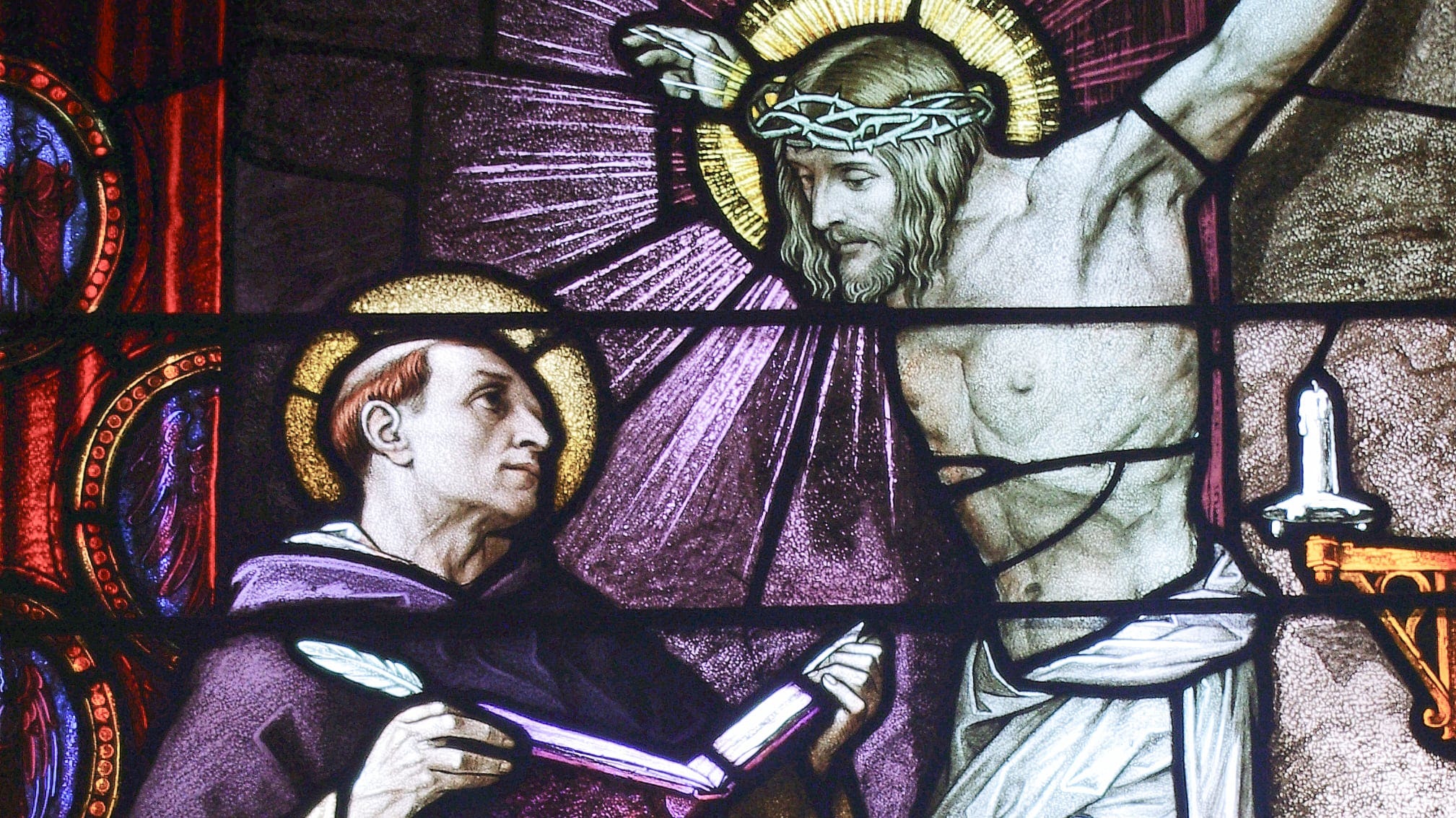
The world is blessed to have had St. Thomas. It seems God was pleased with his work. Toward the end of his life (he died at 49 years old), Aquinas reportedly had a mystical experience. He heard a voice from a crucifix saying, “Thomas, you have written well of me. What do you want as your reward?” He said in response: “Nothing but You, O Lord2.”
The Church canonized him in 1323 and named him a doctor of the Church in 1567. He is known as one of the Church’s greatest theologians and colloquially called the “Angelic Doctor.”
This liner note grew out of a song series that asks: What if rock songs are prayers? Explore the song projects →
Tagged: Liner Notes
Timothy Renick, Aquinas for Armchair Theologians.
Was St. Thomas a ... um ... large man, as I suggested? No, argues @cordithicus, based on illuminated manuscripts and anecdotal evidence: https://substack.com/home/post/p-202345658