
Did St. Augustine Rock?
Augustine turned his own spiritual crisis into one of the most influential accounts ever written of a soul searching for God.
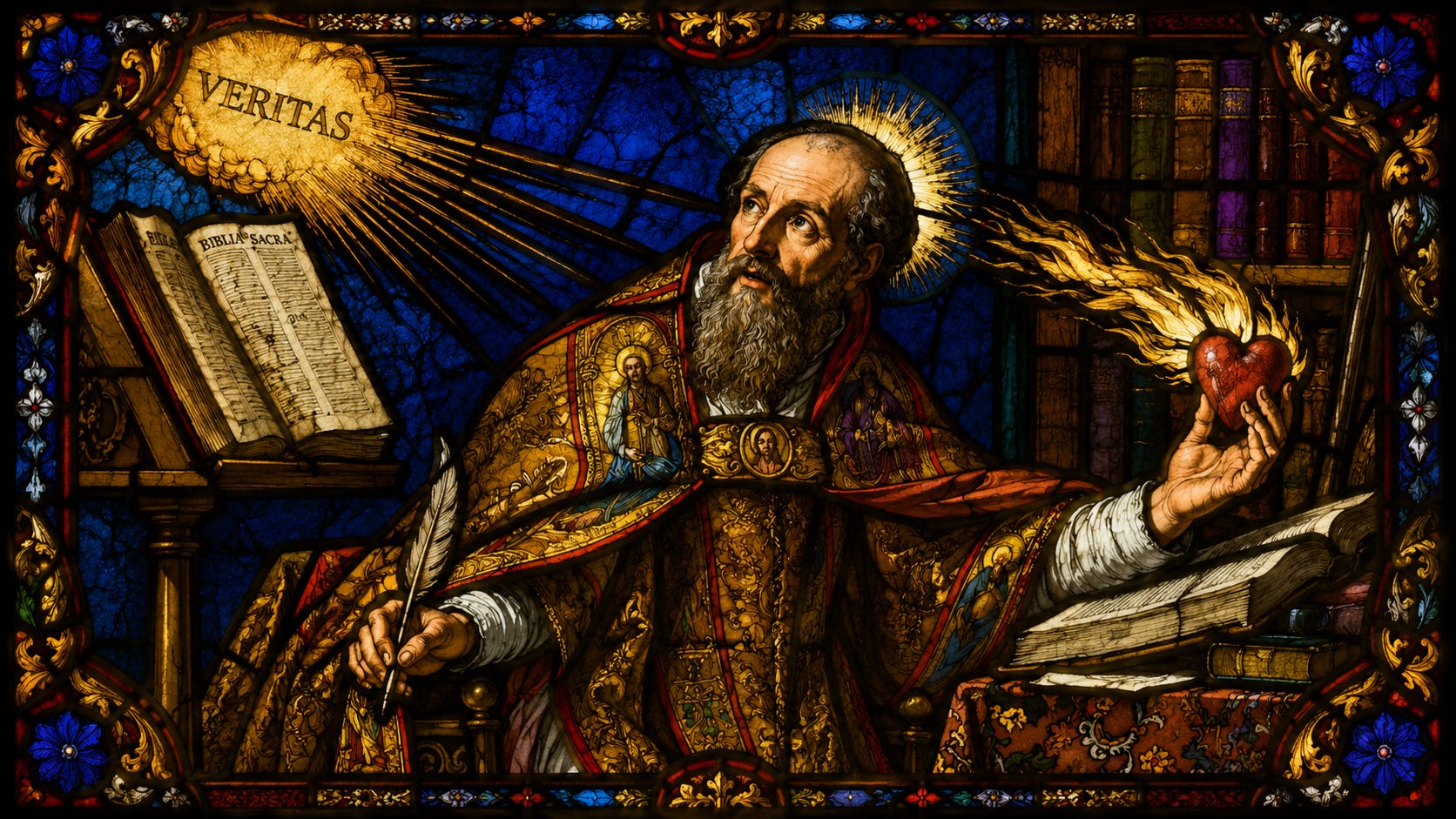
New to Spirituality of Rock? Learn about this project.
Yeah, St. Augustine rocked. (Hey, Bob Dylan saw him in a dream.)
Have you ever asked yourself: Why did I do what I did? Where is God? How did I land on the wrong path so I could find my way back to the right one? You’re not alone, Augustine did, too.
A foundational theologian of the Catholic Church and one of the most influential philosophers of the Western world, Augustine’s work still resonates not just with the Church, but with everyday people.
He was, according to author Stephen Cooper, “a thinker who plumbed the depths of the human soul1.” In fact, his most famous work, Confessions, is a personal “odyssey of the soul, a story of one person’s pilgrimage through this life” that continues to resonate because many people recognize his story as their own
Augustine, born in what is now Tunisia in 354, was originally destined for Roman dignitas in the Western Empire. He was a smart kid, and his parents put him on track for an academic career that would lead to a good marriage and government job.
But things ended differently, and not for a lack of talent or effort. He eventually landed in the Imperial capital in Milan, achieving an appointment to the highest level of teaching Latin rhetoric.
And it was there he heard the call to conversion that would change the course of not only his life, but of the Church and Western thought.
Contrary to popular belief, Augustine was never a pagan. But he wasn’t a Christian either. Early in his life he fell in with a group of Manichees, a movement influenced by gnostic ideas. Looking to scratch the itch created by his growing intellect, their complex beliefs were more stimulating to him than the Christianity he knew.
He left them and Africa for Rome and later Milan to teach rhetoric. His mom, Monica, followed, hoping for his conversion. Her sustained prayers and relentless persistence eventually convinced him to take seriously the riskier social path of Catholicism over the safer career path offered by Roman society.
After fits and starts — along with questioning and skepticism — he turned a corner. His conversion came in a garden. He heard a child’s voice in the distance calling him to read. He opened Romans and happened to turn to the passage where Paul exhorts readers to “put on the Lord Jesus Christ, and make no provision for the desires of the flesh2.” In that moment, Augustine changed.
Thank God he did.
Augustine would go on to become Bishop of Hippo, not far from his birthplace, and write more than 60 surviving texts, among them Confessions and City of God. He is known as one of the most prolific authors of Latin literature.
His theology continues to shape Catholic thought in such areas as grace, Christian anthropology and free will, original sin, just war, and the relationship between church and state. His approach to synthesizing ancient philosophy with emerging Christian theology laid the groundwork for the later Medieval theology further developed by St. Thomas Aquinas and the Scholastics. (Liner note: Did St. Thomas Aquinas Rock? →)
He also opposed Manichaeism, which he once embraced. And thanks to him we know about his mother, St. Monica.
He is a Church Father and Doctor of the Church, known colloquially as the Doctor of Grace, who famously declared to God: “Our hearts are restless until they rest in you.”
This liner note grew out of a song series that asks: What if rock songs are prayers? Explore the song projects →
Tagged: Liner Notes
Stephen Cooper, Augustine for Armchair Theologians
Rom. 13:14