
Did Dante Alighieri Rock?
Seven hundred years before rock music, Dante was writing about sin, redemption and the soul’s search for God.
New to Spirituality of Rock? Learn about this project.
Yeah, Dante rocked.
How do we know that an Italian poet, born in 1265 and who wrote about sin, redemption and the soul’s search for God, rocked? The tip-off is his name — we refer to him by his first, like Bono, Sting, Cher, Prince or Madonna.
We can’t be sure he’d be writing rock songs today, but poems in his time were sung. Sometimes badly. We have a story, likely apocryphal but fun nonetheless, about Dante, who heard a blacksmith singing one of his poems out of tune and mutilating the words. Offended by the rendition, Dante grabbed some of the smith’s tools and threw them into the street. The blacksmith was furious, and Dante said to him: “If you don’t want me to ruin your things, don’t ruin mine1.”
Was Dante crazy? Imagine you were pulling into the Freehold Raceway Mall, singing Born to Run at the top of your lungs and botching it. You drive past Bruce Springsteen in the parking lot by Primark. He hears you destroying his song, carjacks you, and ditches your car under the Route 9/Throckmorton overpass, where he torches it so you can never sing Born to Run again. That’s basically what Dante was said to have done to the blacksmith.
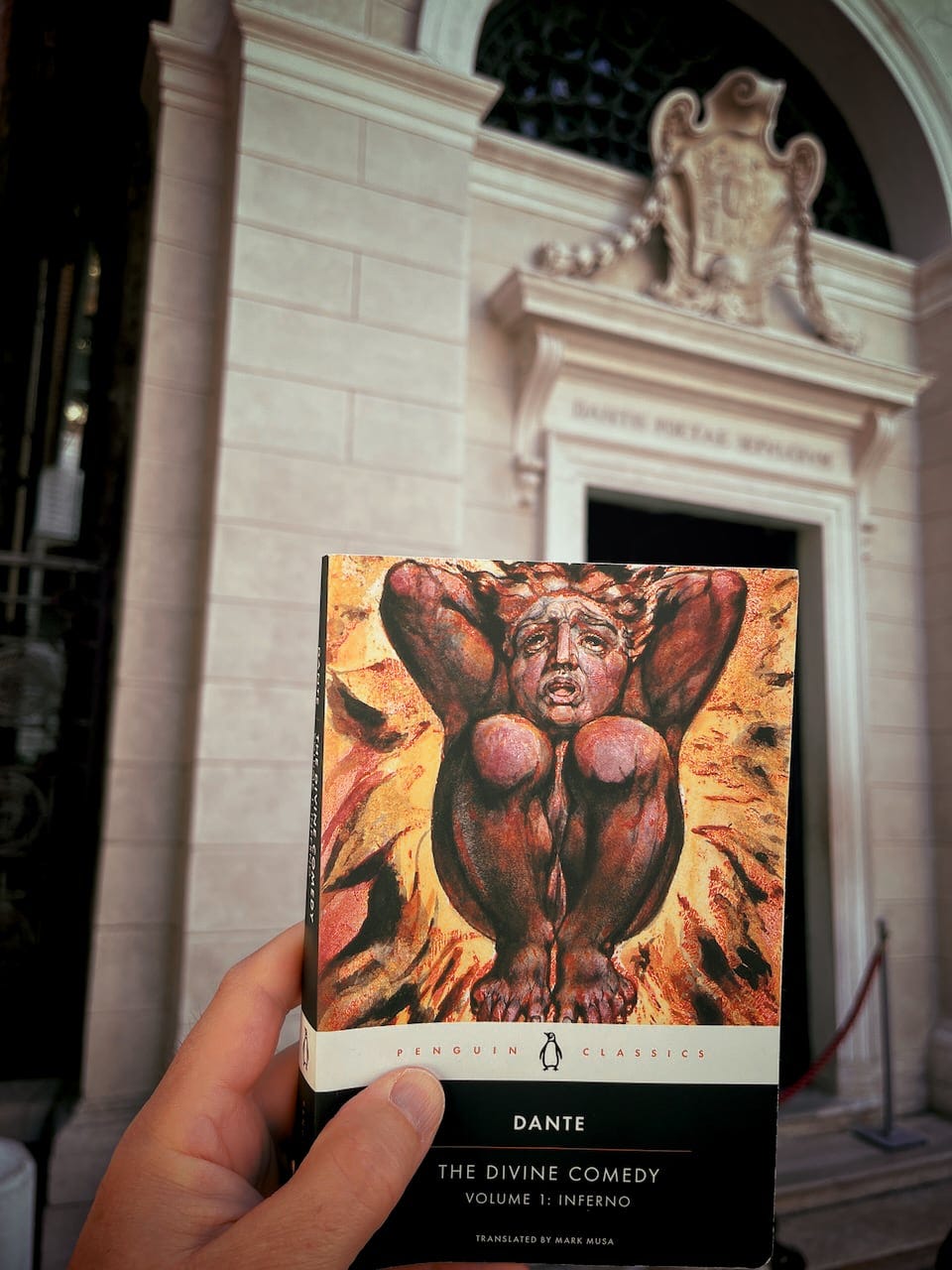
Dante is most famous for writing the Divine Comedy. In this epic poem, the first part, Inferno, is best known. But “not much is known about Dante Alighieri,” according to Mark Musa in his 40-page introduction to Inferno2.
We do know that Dante was born in Florence to a noble family (Dante claimed to be a descendant of Roman nobility). He lived in the tumultuous sea of Italian politics that pitted Papal and imperial supporters against each other. This would eventually lead to his exile from Florence, under the threat of death. He wrote allies, enemies and other public figures of his time into the Divine Comedy.
He taught himself to write verse. The Roman poet Virgil was his artistic hero, and he studied Virgil’s work as if the ancient poet were his chief tutor. Dante was also versed in Scholastic theology of St. Thomas Aquinas, which is deeply interwoven into the Divine Comedy. (Sidebar: Did St. Thomas Aquinas Rock? →)
But however influential Florentine politics, Virgil and the Scholastics were on him, Beatrice dwarfed them all. An acquaintance he encountered in his youth, she became the emotional center of his work. She died young, and Dante’s fondness for her led him to characterize Beatrice as “a model of virtue and courtesy, a miraculous gift given to earth by God,” wrote Mr. Musa. She would appear many times in Dante’s work and plays a heavenly role in the Divine Comedy.
And while it’s over 700 years old, the Divine Comedy remains a very readable text, especially the Musa translation. He avoids rhymes, making it read like a narrative (though poetry fans will appreciate the text’s iambic pentameter rhythm). It is, for me, a treasure. If you read the Divine Comedy, which I really hope you do, Mark Musa in his three-volume edition (which includes Inferno, Purgatorio and Paradiso) provides what amounts to a college course on the text through his associated commentary. It is nothing short of excellent.
This liner note grew out of a song series that asks: What if rock songs are prayers? Explore the song projects →
Tagged: Liner Notes
“Novella NCXIV,” Franco Sacchetti a Puntate, Nov. 2016.
Mark Musa, introduction to Inferno.